Oklahoma Prisons Inmate Search
NEED TO KNOW
- Prison and jail are separate databases. Prison = sentenced over one year. Jail = arrested, booked, or under one year.
- ODOC at okoffender.doc.ok.gov shows current inmates, parolees, and released individuals. Records stay unless expunged.
- No single statewide jail roster exists. Each county sheriff manages their own.
- “Outside” on ODOC means released or paroled, not escaped.
- Court records and prison records are different systems with different information.
Someone close to you got arrested in Oklahoma. Or maybe you heard a name and want to know if that person is sitting in a cell right now.
The problem is, Oklahoma splits inmate information across multiple systems. None of them talk to each other.
State prison records live in one place. County jail rosters live in another. Federal inmates sit in a completely different database.
Search the wrong one and you get nothing back. You assume the person is free when they might not be.
This guide breaks down every database, what it actually contains, where each one falls short, and how to connect the dots.
I am Muhammad Zarrar, a Public Records Researcher with a Bachelor of Criminal Justice. This guide is informational only and is not affiliated with ODOC, OSCN.net, or any government agency.
Why Oklahoma Has Multiple Inmate Databases
Most people expect one search tool that covers everything. Oklahoma does not work that way.
The state separates inmates based on where they are held and who runs the facility. Each authority maintains its own records.
State prisons fall under the Oklahoma Department of Corrections (ODOC). They house people convicted of felonies and sentenced to more than one year.
ODOC operates 23 facilities across the state.
County jails are operated by each county’s sheriff. These hold people who were recently arrested, those awaiting trial, and anyone sentenced to less than 12 months.
Oklahoma has 77 counties. Each one runs its own jail and its own records system.
Federal prisons in Oklahoma are managed by the Federal Bureau of Prisons (BOP). Three federal facilities operate in the state.
Federal inmates do not appear in the ODOC search or on any county jail roster.
A single name search on one system will never give you the full picture. You have to check multiple sources depending on what you are looking for.
ODOC Offender Lookup: What It Actually Shows
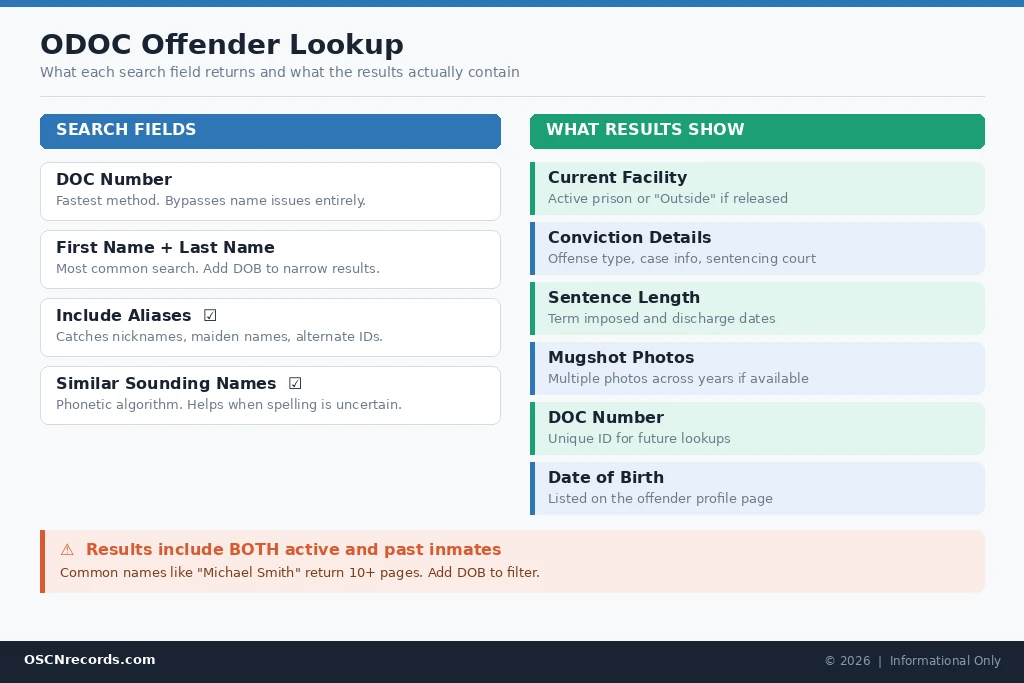
The main tool most people use is the ODOC offender search at okoffender.doc.ok.gov.
It is free. No account needed. Accept the terms and conditions page, and a search form appears.
Here is what most guides skip: this database does not only show people currently behind bars.
It includes everyone who has ever been through the Oklahoma state prison system. Current inmates, people on parole, probation through DOC supervision, and people released years ago all show up in the same results.
That creates a specific problem. Search a common name like Michael Smith and you will get ten or more pages of results.
Active and past inmates are mixed together. The system does not let you filter by status before you search.
What you can search by:
- The DOC number is the fastest option if you have it. Otherwise, enter a first and last name.
- Date of birth helps narrow results when the name is common.
- Two checkboxes on the form are worth knowing about. One includes alias names. The other includes similar sounding names using a phonetic matching algorithm.
- Turn on the alias option if you are not sure the person goes by their legal name.
What shows up in results:
- Each result gives you a name, DOC number, date of birth, and current facility.
- Click into a profile and you get conviction details, sentence length, discharge dates, and mugshot photos.
- Oklahoma keeps multiple mugshots over time. If someone has been in and out across several years, you might see four or five photos spanning a decade.
- That can help with identification when the person’s appearance has changed.
What “Outside” means:
- When the current facility field says “Outside,” the person is no longer in a DOC facility.
- They finished their sentence, paroled out, or completed their probation.
- The record stays in the database permanently unless the person gets an expungement through the court system.
County Jail Searches: A Different System Entirely
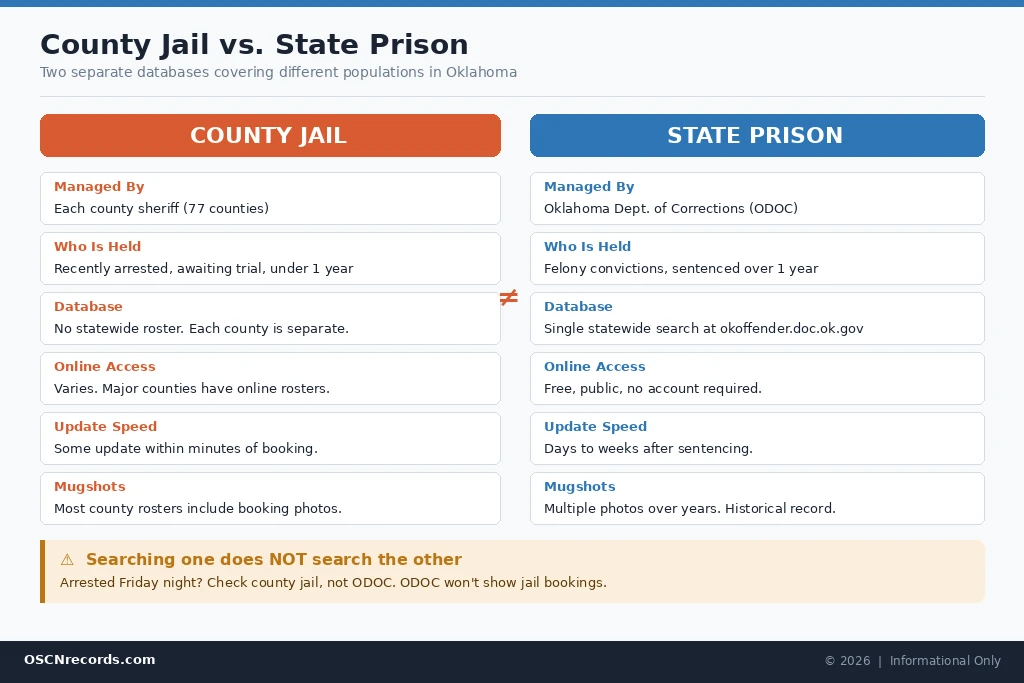
People get confused here more than anywhere else.
Someone gets arrested on a Friday night. A family member searches ODOC the next morning and finds nothing.
They assume the information is wrong. But the person is sitting in a county jail, not a state prison. County jails do not report to ODOC.
County jails hold three categories of people: those just arrested and booked, those awaiting trial who have not posted bond, and those serving sentences shorter than one year.
A large number of people who go through the criminal justice system in Oklahoma never make it to a state prison at all.
How to search county jails:
There is no statewide county jail search. Each county sheriff runs their own roster.
Some counties post their current inmate list online with names, charges, booking dates, and bond amounts. Others require a phone call.
Oklahoma County maintains a jail roster and a separate warrant search tool through the sheriff’s office.
Tulsa County posts booking information through its own online jail database on the Tulsa County Sheriff’s site.
Cleveland County, Canadian County, Comanche County each has its own system. Some update within minutes of a new booking. Others take a full business day.
Smaller and rural counties may not have any online roster at all. Calling the sheriff’s office directly is the only option.
Jail records and prison records serve different purposes and cover different populations. Checking one without checking the other leaves a gap.
Federal Inmates in Oklahoma
Oklahoma has three federal prison facilities. People convicted of federal crimes serve time here.
That includes drug trafficking across state lines, bank robbery, federal fraud, or immigration offenses.
Federal inmates do not appear in ODOC searches or on any county jail roster.
The Federal Bureau of Prisons Inmate Locator is the tool for this. You can search by name, BOP register number, or other federal identifiers.
It covers every federal facility in the country, not just Oklahoma.
If someone committed a crime under federal jurisdiction, searching only at the state level will return nothing.
OK VINE: Tracking Custody Changes in Real Time
Most people think OK VINE is only for crime victims. It is not.
Anyone can use it.
VINE stands for Victim Information and Notification Everyday. It tracks inmate custody status across jails and prisons in the Oklahoma VINE network.
Search at vinelink.vineapps.com or call 1-877-654-8463.
The real value of VINE is not just the search. You can register to receive automatic alerts when a specific person’s custody status changes.
That includes transfers between facilities, releases, and escapes. Notifications come by phone, text, email, or through the VINELink mobile app.
Neither ODOC nor county jail rosters will notify you when something changes. You have to keep checking manually.
VINE does the checking for you and sends an alert the moment a status update hits the system.
One thing to keep in mind: VINE tracks custody status only. It does not provide conviction details, sentencing breakdowns, or court documents.
For that level of detail, you need court records.
How Prison Records Connect to Court Records
A prison record tells you where someone is held, how long their sentence runs, and when they might get out.
A court record tells you what actually happened in the case. The charges filed, the plea entered, the motions argued, and the final outcome.
These two systems overlap but do not duplicate each other.
Someone might appear in the ODOC database with a conviction and an eight-year sentence. But the court docket on OSCN will show the full history.
That includes the original charges (which might differ from the final conviction), plea deals, the sentencing hearing, appeals, and post-conviction motions.
If you need the full story, you check both. Prison records give you the current status. Court records give you the timeline.
This matters especially when someone has multiple cases across different counties.
ODOC consolidates everything under one DOC number. But court cases remain separate, filed in whichever county the crime occurred.
A person serving time for offenses in both Tulsa County and Oklahoma County will have two separate court cases on OSCN but one combined record in ODOC.
Common Mistakes That Return Zero Results
Small errors produce empty results and waste time. Here are the patterns that trip people up most often.
Searching the wrong database. Person arrested two days ago? County jail, not ODOC.
Federal crime? BOP, not ODOC. City traffic ticket and a night in municipal lockup? That is a city facility, not county or state.
Misspelling the name. The ODOC search does not handle typos. One wrong letter and the person does not show up.
Try the “similar sounding names” checkbox if you are not sure of the exact spelling.
Not knowing the legal name. People go by nicknames, middle names, or maiden names. The database stores the legal name from booking documents.
Turn on the alias search option to catch alternate names.
Expecting immediate results after an arrest. State prison records do not update the moment someone is sentenced.
After conviction, a person goes through intake and assessment at a reception center before being assigned. That process takes days to several weeks.
Confusing “no results” with “not in custody.” An empty result means the person is not in that specific database.
It does not mean they are free. They could be in a county jail, a federal facility, or a different state entirely.
Searching Beyond Oklahoma State Lines
People move. Someone living in Oklahoma today may have served time in Texas, Kansas, or Arkansas before relocating.
Oklahoma’s ODOC search only covers the Oklahoma state prison system. It will not show convictions or incarceration from another state.
Each state runs its own department of corrections with its own offender search. You would need to search each state individually.
The Federal Bureau of Prisons covers all federal facilities nationwide. A single search there handles the federal side across every state.
For a paid option, the Oklahoma State Bureau of Investigation (OSBI) runs background checks through its CHIRP portal at $15 per search.
CHIRP pulls from Oklahoma’s statewide criminal history database and can surface records that a simple ODOC name search misses.
Private background check services aggregate records from multiple states, but accuracy varies. They often lag behind real-time status changes.
What Happens to Records After Someone Is Released
One question comes up constantly: does a prison record disappear when the person gets out?
No.
In Oklahoma, ODOC records remain in the database after release. The facility field changes to “Outside” and the discharge date populates.
But the full record stays visible. Conviction, sentence, mugshots, facility history — all of it remains public.
This is by design. The ODOC database is a historical record, not a list of who is currently locked up.
The only way a record gets removed is through a legal expungement.
That requires filing a petition in the sentencing court, meeting Oklahoma’s eligibility requirements, and obtaining a court order. Not every conviction qualifies.
The process typically requires an attorney. Until an expungement is granted and processed, the record stays public.
Sending Money, Messages, and Scheduling Visits
Finding someone in the system is usually just the first step. The next question is how to stay connected.
Sending money: ODOC uses an offender banking system. Deposits go into an inmate’s trust account for commissary purchases.
The process is outlined on the ODOC offender banking page. Always verify third-party deposit services are approved by the facility first.
Phone calls and messages: Oklahoma’s prison phone system is managed by a contracted provider. Inmates must add approved numbers to their calling list.
Details about setup and rates are on ODOC’s inmate phone information page.
Visitation: Each ODOC facility sets its own schedule and rules. You need to complete a visitor application through ODOC first.
Approval can take several weeks. Walk-in visits without prior approval are not allowed at state prison facilities.
County jails handle visitation differently. Some offer in-person visits, many have moved to video visitation.
Contact the specific facility directly for their current process.
Legal Boundaries When Using Inmate Records
Inmate records are public in Oklahoma under the Oklahoma Open Records Act (51 O.S. § 24A).
But “public” does not mean “use however you want.”
If you use inmate records for hiring, housing, or credit decisions, federal law kicks in. The Fair Credit Reporting Act has specific requirements for criminal history in those contexts.
Publishing someone’s record with inaccurate information or malicious intent can expose you to defamation claims.
Sharing records that have been expunged is a separate legal violation in Oklahoma.
The ODOC search page carries a disclaimer: the department assumes no legal responsibility for accuracy or completeness. Treat results as a starting point, not a certified document.
For anything with real consequences — custody disputes, hiring decisions, licensing — get certified records from the court clerk or consult an attorney.
FAQs
How do I find someone currently in an Oklahoma state prison?
Go to okoffender.doc.ok.gov, accept the terms, and enter their name or DOC number. If the facility shows anything other than “Outside,” the person is in that facility now.
Can I search Oklahoma inmates by DOC number only?
Yes. The DOC number field works independently. It is the fastest and most accurate method since it bypasses name spelling issues.
Why does the ODOC search show people who are already released?
The database is a historical record of everyone processed through the state prison system. Released individuals show a facility status of “Outside” and a discharge date. Records remain unless expunged.
Is there a mobile app for Oklahoma inmate search?
ODOC does not offer a dedicated app. The website works in mobile browsers. For custody alerts, the VINELink mobile app covers both jail and prison facilities in Oklahoma’s VINE network.
What is the difference between ODOC and a county jail search?
ODOC covers state prisons — people sentenced over one year for felony convictions. County jail rosters cover people recently arrested, awaiting trial, or serving under one year. Different systems, different populations.
How long does it take for a new inmate to appear in ODOC?
After sentencing, a person goes through intake and classification at a reception center. This can take days to several weeks. Do not expect same-day results.
Can I find out when an Oklahoma inmate will be released?
The ODOC profile includes projected release dates. These dates can shift based on earned credits, disciplinary actions, or parole decisions. VINE notifies you automatically when a release actually happens.
Are Oklahoma juvenile records searchable through ODOC?
No. Juvenile records are confidential by law. They do not appear in ODOC, on OSCN, or on county jail rosters. Access requires a court order.
How do I find an inmate in a federal prison in Oklahoma?
Use the Federal Bureau of Prisons Inmate Locator. Search by name or BOP register number. This is completely separate from the state ODOC system.
Can someone’s ODOC record be removed?
Only through legal expungement. A petition must be filed in the sentencing court, eligibility requirements must be met, and a judge must issue an order. The process typically requires an attorney.
Conclusion
Oklahoma does not make inmate searching simple. Prison, jail, federal, and court records all live in separate systems.
Most failed searches happen because people start in the wrong database.
Someone in a county jail will not appear on ODOC. A federal inmate will not show on either. A person released five years ago still shows up on ODOC as “Outside.”
Start by figuring out what you actually need to know. Then pick the right database.
Currently in state prison? ODOC. Just arrested and in county lockup? The county sheriff. Federal charges? BOP. Want alerts when custody status changes? VINE. Need the full court history behind a conviction? OSCN.
Check the right source first and most searches take under five minutes.
A letter From Muhammad Zarrar

My intention is to provide helpful information for people who do not understand complex legal terminology. I purely provide informational material to help users navigate public court record systems more easily.
I am Muhammad Zarrar, a Public Records Researcher with a Bachelor of Criminal Justice. I research and write guides on OSCN and U.S. court database systems, helping users understand case searches, docket information, and public records access in simple language.
If you need official records or verified court information, please visit the official OSCN website at OSCN.net.
Thank you for visiting. If you found my guide helpful, please leave a comment.